
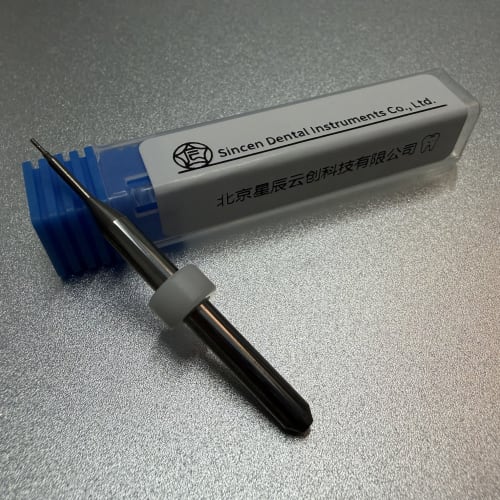
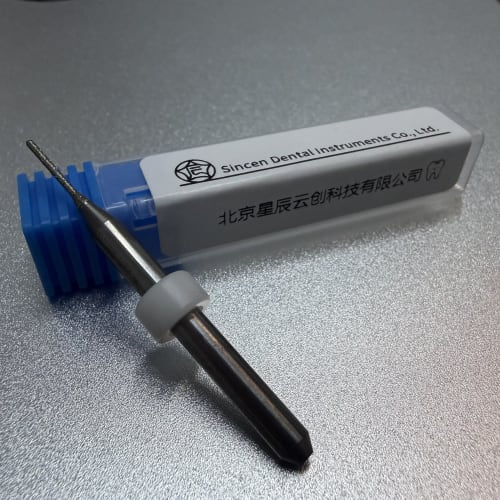
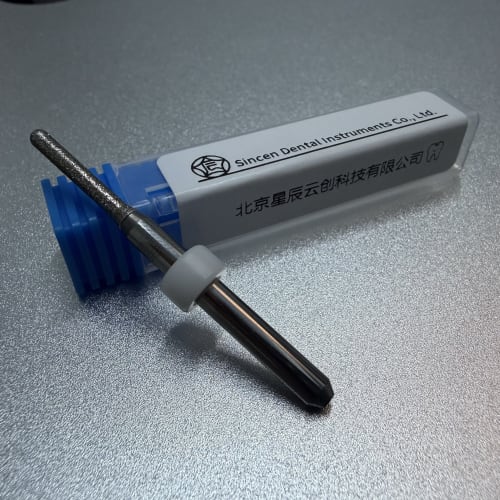
SINCEN Shinva compatible glass ceramic milling burs are diamond-coated rotary instruments designed for wet milling of lithium disilicate (IPS e.max), feldspathic ceramic, Vita Suprinity, and Celtra Duo. They suit chairside and lab production of single crowns, inlays, onlays, veneers, and anterior bridges. Three configurations with a φ4mm smooth shank cover roughing to fine finishing.
| Compatible Machines | Shinva |
|---|---|
| Interface Type | φ4mm Smooth Shank |
| Material Category | Glass Ceramic |
| Configurations | 3 |
| Order No | Specification | Head Ø | Neck | Shank | Length | Inquiry |
|---|---|---|---|---|---|---|
| G-4-0.6 | φ0.6×TL3×φ4×L50 | 0.6 | 3 | 4 | 50 | 1 |
| G-4-1.0 | φ1.0×TL10×φ4×L50 | 1 | 10 | 4 | 50 | 1 |
| G-4-2.5 | φ2.5×TL16×φ4×L50 | 2.5 | 16 | 4 | 50 | 1 |
The φ2.5mm configuration suits bulk material removal in early milling stages, while the φ1.0mm and φ0.6mm configurations are used for intermediate shaping and fine detail work on glass ceramic restorations.
These burs are not for dry milling, metals, or materials outside glass ceramics such as lithium disilicate, feldspathic ceramic, Vita Suprinity, and Celtra Duo.
All three configurations use a φ4mm smooth shank that is collet-clamped in Shinva milling machines.
They are intended for wet milling of lithium disilicate (IPS e.max), feldspathic ceramic, Vita Suprinity, and Celtra Duo.
These burs fit Shinva milling machines that accept a φ4mm smooth collet-clamped shank.
The φ2.5mm configuration removes material efficiently in early stages, the φ1.0mm handles intermediate shaping, and the φ0.6mm is suited for fine details and tight geometries.
No, they are aftermarket burs manufactured by SINCEN Dental, designed to be compatible with Shinva machines.
Watch for visible loss of diamond coating, chipping or rounding of the cutting edge, increased milling noise, rougher surface finish, or longer milling time.
No, they are specified for glass ceramics only. They are not intended for zirconia, metals, or other material classes.