
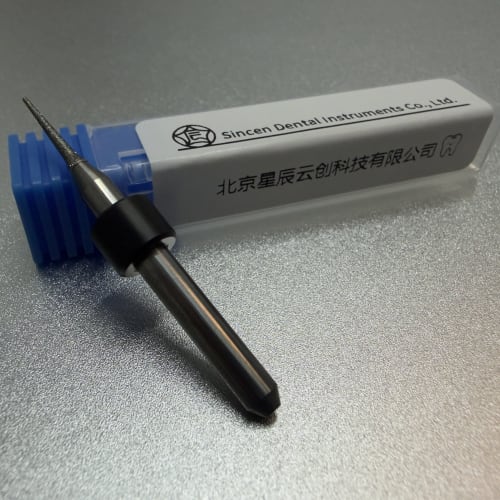
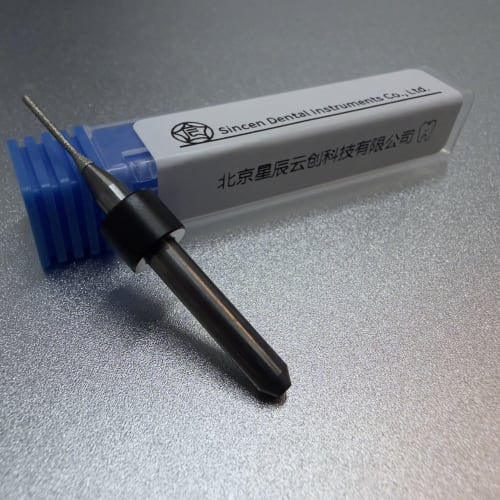
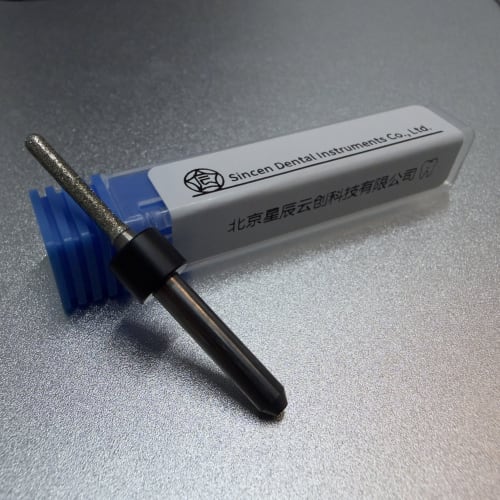
SINCEN Dental offers diamond-coated milling burs for BESMED machines, designed for wet milling of glass ceramics including lithium disilicate (IPS e.max), feldspathic ceramic, Vita Suprinity, and Celtra Duo. Three configurations with φ4mm smooth collet-clamped shanks support CAD/CAM production of single crowns, inlays, onlays, veneers, and anterior bridges in chairside or lab workflows.
| Compatible Machines | BESMED |
|---|---|
| Interface Type | φ4mm Smooth Shank |
| Material Category | Glass Ceramic |
| Configurations | 3 |
| Order No | Specification | Head Ø | Neck | Shank | Length | Inquiry |
|---|---|---|---|---|---|---|
| G-4-0.6 | φ0.6×TL10×φ4×L45 | 0.6 | 10 | 4 | 45 | 1 |
| G-4-1.0 | φ1.0×TL10×φ4×L45 | 1 | 10 | 4 | 45 | 1 |
| G-4-2.5 | φ2.5×TL16×φ4×L45 | 2.5 | 16 | 4 | 45 | 1 |
The φ2.5 head diameter suits roughing and bulk material removal; the φ1.0 head diameter suits semi-finishing; the φ0.6 head diameter suits fine detail and finishing passes.
These burs are not for milling metals or for dry milling applications.
All three configurations use a φ4mm smooth shank that is collet-clamped, matching BESMED machine interfaces.
They are designed for wet milling of lithium disilicate (IPS e.max), feldspathic ceramic, Vita Suprinity, and Celtra Duo.
The burs are compatible with BESMED machines that accept φ4mm smooth shank collet-clamped tools.
Use φ2.5 for roughing and bulk material removal, φ1.0 for semi-finishing, and φ0.6 for fine detail and finishing passes.
Look for reduced cutting efficiency, increased milling time, visible loss of diamond coating on the cutting edges, or surface chipping on the milled restoration.
No, these burs are designed for wet milling of glass ceramics only.
No, these are SINCEN Dental aftermarket burs manufactured to be compatible with BESMED machines.