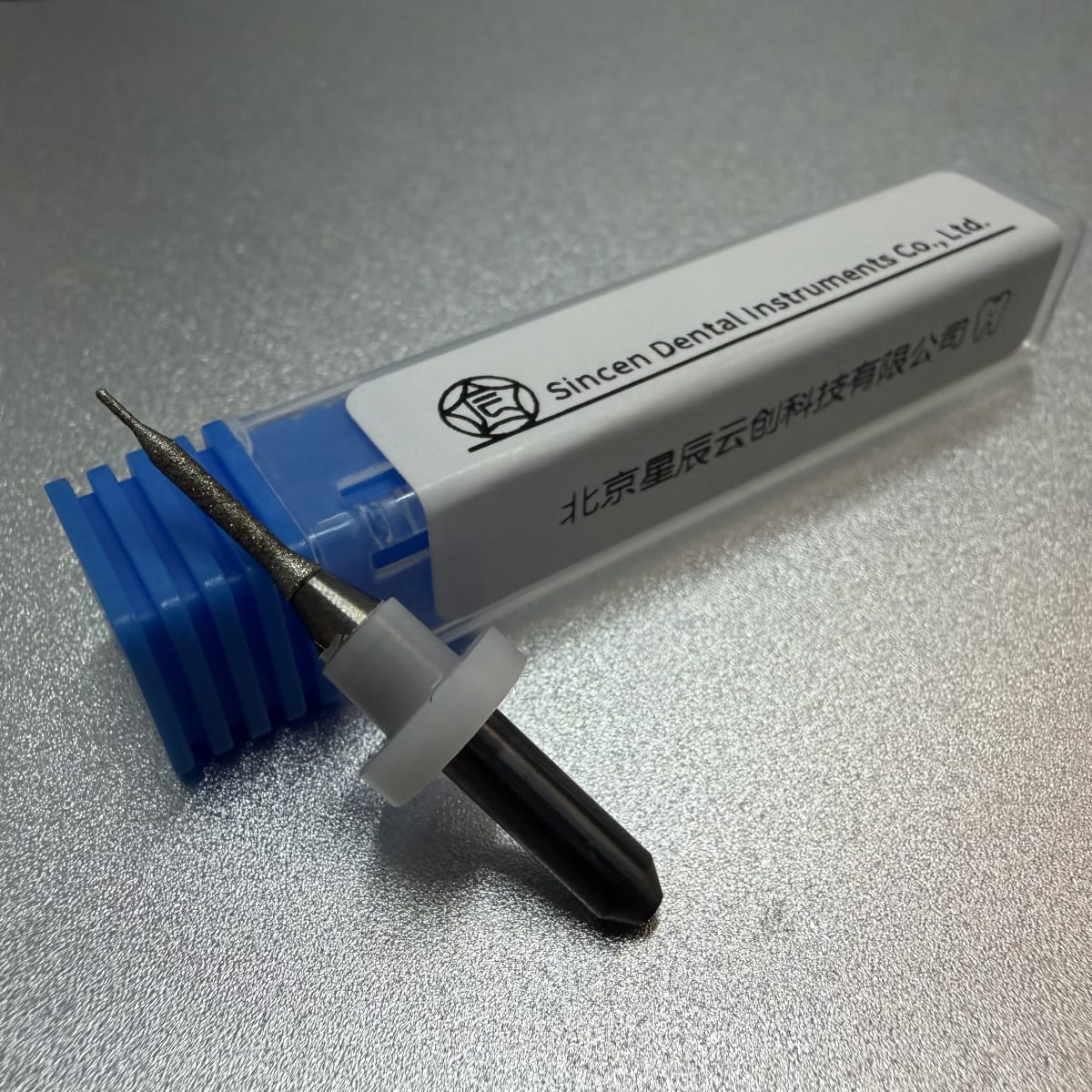
Diamond-coated milling burs for AIM dental milling machines, designed for wet milling of glass ceramics including lithium disilicate (IPS e.max), feldspathic ceramic, Vita Suprinity, and Celtra Duo. Suitable for single crowns, inlays, onlays, veneers, and anterior bridges in chairside or lab workflows. Available in three φ4mm smooth shank (collet-clamped) configurations.
| Compatible Machines | AIM |
|---|---|
| Interface Type | φ4mm Smooth Shank |
| Material Category | Glass Ceramic |
| Configurations | 3 |
| Order No | Specification | Head Ø | Neck | Shank | Length | Inquiry |
|---|---|---|---|---|---|---|
| G-4-0.5 | φ0.5×TL3×φ4×L36 | 0.5 | 3 | 4 | 36 | 1 |
| G-4-1.0 | φ1.0×TL10×φ4×L34 | 1 | 10 | 4 | 34 | 1 |
| G-4-2.0 | φ2.0×TL15×φ4×L38 | 2 | 15 | 4 | 38 | 1 |
The φ2.0 head diameter is suited for roughing or bulk material removal, while the φ0.5 and φ1.0 head diameters are suited for finishing and fine detail work on glass ceramic restorations.
These burs are not intended for metal milling, dry milling, or use in machines that require threaded shanks such as Sirona CEREC MC, MC X, MC XL, or CEREC 3.
All three configurations use a φ4mm smooth shank (collet-clamped) interface, compatible with AIM milling machines. This is not a threaded shank.
No. Sirona CEREC MC, MC X, and MC XL use a proprietary M3.5 threaded shank, not a φ4mm smooth shank. CEREC 3 uses M1.8. These burs are specifically for AIM machines with collet clamping.
They are designed for wet milling of glass ceramics: lithium disilicate (IPS e.max), feldspathic ceramic, Vita Suprinity, and Celtra Duo.
Select based on required detail level and milling stage. Smaller diameters (φ0.5) suit fine detail and finishing operations, while larger diameters (φ2.0) are appropriate for roughing or bulk material removal. The φ1.0 offers an intermediate option.
Monitor for visible signs of coating wear, reduced cutting efficiency, increased milling time, or deterioration in surface finish quality on the milled restoration. Replace when these signs appear rather than after a fixed number of units.
No. This is a SINCEN-manufactured bur designed for compatibility with AIM milling machines. It is an aftermarket option with lab-friendly wholesale pricing.